
AI in construction: Understanding its real impact on the jobsite


Artificial intelligence is rapidly becoming an important part of how construction projects are planned and executed. The global AI in construction market is projected to reach $16.96 billion by 2030, signaling a clear shift from experimentation to industry-wide adoption.
For contractors, this means AI-enabled workflows are quickly becoming the norm, not a differentiator, as owners and clients increasingly expect faster delivery, better visibility, and data-driven decision-making.
From reporting to safety and quality control, AI is reshaping day-to-day operations across the jobsite and office. This article explores how AI is being used in construction today, the benefits and measurable ROI it delivers, and what teams can do to prepare for a smarter, more connected reality.
Key takeaways
- AI in construction is scaling rapidly, with the market projected to reach $16.96 billion by 2030, signaling industry-wide adoption.
- AI delivers measurable ROI, including 20% cost reduction, 31% productivity gains, and 10–25% shorter project timelines.
- Safety and quality improvements are significant, with AI reducing workplace accidents by up to 35% and rework by 25%.
- From design and planning to reporting and QA/QC, AI is transforming both field and office workflows by automating tasks and improving accuracy.
- Despite its potential, adoption remains low, meaning contractors who invest early can gain a competitive edge as AI becomes standard.
The impact of AI in construction
From reactive problem-solving to predictive management, AI is promoting a broad transformation of the construction industry, changing how teams collaborate, make decisions, and deliver projects.
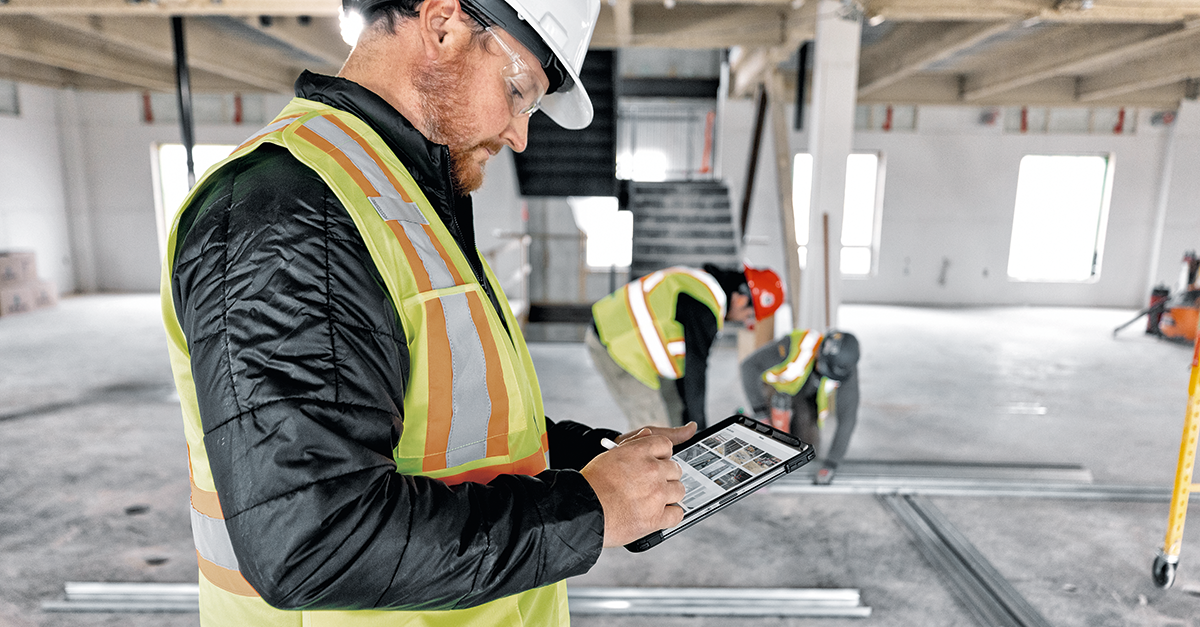
The impact of AI can be seen on day-to-day field tasks, with voice assistants that help teams search for the right information, or AI photo tagging that organize project documents quickly. These tools can reduce time spent on non-productive tasks, and get teams focused on high-impact work.
At a strategic level, artificial intelligence is changing how contractors plan and monitor their projects. The technology available can predict delays, automate schedules, and have a great impact on risk forecasting. The next section of this article will detail how AI is being applied on construction sites to improve productivity and safety.
How is AI used in construction
From design to construction and then maintenance, AI tools are already being applied to office and field workflows to reduce mistakes, increase safety and save time.
Design and pre-construction
Architects and engineers can use generative design tools to evaluate millions of possibilities and create design options based on parameters like structural load or energy efficiency. Other variables, such as site conditions, budget and material constraints can also be taken into account by AI tools to help reduce iterations and enable more cost and time effective designs.
Planning and scheduling
Project schedule optimizers can be used to suggest the best scheduling for teams, tasks and material deliveries. This technology can appraise endless alternatives to deliver the best option for a project, and also correct itself over time. With reinforcement learning, AI tools can analyse data from similar projects to learn based on trial and error, and make better schedule optimizations the more it's used.
Safety
AI and computer vision are increasingly used to spot safety risks and prevent accidents, both in design and on the jobsite. AI-powered BIM models are boosting project constructability by forecasting potential issues before – or during – construction. Drone imagery can be analyzed by machine-learning systems to detect hazards such as missing PPE or unsafe proximity to heavy machinery.
Reporting
AI can optimize construction reporting by automatically pulling field data (photos, notes, weather updates) from jobsite management software and turning it into structured summaries. This improves accuracy and saves time spent on paperwork.
Quality control
AI is reshaping QA/QC in construction by pairing computer vision with automated inspection tools. Drone imagery, laser scans, and 3D models can be compared with design specifications to detect defects, making quality control management more efficient.
Want to go deeper into construction best practices? Explore more insights on jobsite efficiency and project management in our blog to stay ahead in a rapidly evolving industry.

Benefits of using AI in construction
Cost reduction
AI helps identify inefficiencies in workflows, material usage, and scheduling, reducing unnecessary spending and preventing costly mistakes before they occur.
Improved efficiency
Automation of routine tasks, like progress tracking and reporting, frees teams to focus on higher-value activities, speeding up project timelines.
Increase in productivity
AI-powered resource management and predictive planning ensure that labor, equipment, and materials are used optimally, enabling teams to complete more work in less time.
Better decision-making
By analyzing vast amounts of project data, AI provides actionable insights for project managers, helping them anticipate risks, resolve bottlenecks, and adjust plans proactively.
Improved safety
AI tools such as computer vision and wearable sensors can detect unsafe behaviors or site hazards in real time, allowing for immediate intervention and reducing accidents.
The ROI of AI in construction
More than a buzzword, AI is driving quantifiable improvements in cost, productivity, and overall project performance in construction.
AI implementation in the construction industry is projected to reduce project costs by 20% worldwide by 2030, according to a global report. Construction productivity is expected to grow by 31% thanks to AI-powered tools like BIM, digital twins, robotics, and automation.
Research shows AI adoption in construction can shorten project delivery timelines by 10–25%. Case studies in Italy, Spain, and France showed that AI solutions can reduce workplace accidents by 35%. Moreover, AI quality control can reduce construction rework by 25%.
This ROI stems from better processes, such as reducing manual workflows, predicting risks before they materialize, and optimizing resource allocation, rather than simply adding technology for its own sake.
AI ROI in construction
- AI could reduce project costs by 20% by 2030.
- Productivity may increase by 31% with AI-powered tools.
- AI can cut workplace accidents by 35%.
- AI-driven QC can reduce rework by 25%.
- AI adoption can shorten delivery timelines by 10–25%.

Adopting AI in construction
While AI promises major benefits, only 12% of construction workers regularly use AI in specific processes. This low adoption rate may be explained by the challenges construction teams face when trying to implement new technologies.
Common hurdles include low digital maturity within organizations, a shortage of skilled staff, and resistance to change from teams used to traditional workflows. Fragmented data across multiple systems can also be a problem, since AI works through data analysis to spot trends and deliver insights.
To overcome these challenges, contractors can take practical, step-by-step actions:
Start with digitized workflows – Convert paper-based processes into centralized, digital systems.
Centralize your data – Ensure that AI tools have access to consistent, high-quality data from across projects and departments. __ Pilot small projects first__ – Implement AI in a single workflow, site, or project phase to measure its impact and refine processes before scaling.
Upskill teams gradually – Train project managers, site supervisors, and engineers on AI tools to build confidence and expertise.
Communicate benefits clearly – Show teams how AI reduces repetitive tasks, improves safety, and supports decision-making to ease resistance.
Research shows that experience with simpler, user‑friendly digital tools can inform the adoption of more advanced AI systems. By focusing on adoption readiness and starting small, construction teams can gain early wins, demonstrate tangible results, and build internal momentum for wider AI deployment.
The road to smarter construction
AI is no longer the future of construction, it’s the present. Systems equipped with artificial intelligence are already reshaping how teams plan, execute and manage projects, and their ROI becomes more and more evident.
But leveraging the benefits of AI is not only a matter of buying the latest tools. Technology, process, and culture are equally important to succeed with AI implementation.
As these technologies continue to mature, the greatest gains will come from connecting data, people, and workflows in one place to enable faster collaboration and better decision-making.
Ready to bring these AI-driven improvements to your construction projects? Discover how connected construction tools can streamline reporting, improve coordination, and help your teams work more efficiently.


