
Where do you start? A practical technology roadmap for mid-sized contractors

Every conversation I have with mid-sized contractors eventually circles back to the same question: where do we actually begin? There's no shortage of technology options in the construction industry right now. But more options don't make the decision easier, especially when resources are lean and the margin for error is low.
The good news is that most contractors don't need a massive transformation to see meaningful results. They need a clear starting point, a logical sequence, and the discipline to prove value before scaling. What follows is the framework I share with contractors who are ready to move forward but aren't sure how.
Start with an honest look at where you are
Before evaluating any software, it's worth stepping back and diagnosing your current state. This sounds obvious, but it's a step many teams skip in their rush to find a solution. Without a clear picture of the friction points, technology purchases don’t reach their full potential.
One thing I'd encourage every leader to do: ask the people doing the work. Your superintendents, foremen, project managers, and engineers know exactly where the friction is. They live it every day. Their answers will be more useful than any benchmarking report.
A few questions worth asking your team:
- How quickly does information flow between the field and the office?
- How often are crews working from outdated drawings?
- How much time goes into finding information rather than acting on it?
From there, map your actual workflows. Follow an RFI from submission to resolution. Trace how a change order gets processed. Look at how drawings are updated and distributed, and how QA/QC gets documented. This exercise tends to surface the real bottlenecks quickly and help identify where exactly time gets lost.

Evaluate technology with discipline
Once you understand your gaps, the evaluation process becomes much more focused. Rather than asking “what's the best platform out there,” you can ask “what solves our specific problem, and will our teams actually use it?”
A few principles that tend to separate good technology decisions from costly ones:
- Separate must-haves from nice-to-haves. Features that solve your core problem are what matter. Everything else is a distraction at this stage.
- Bring field voices into the selection process. Tools that get chosen without field buy-in often get abandoned in the field. The people who will use it daily have the most relevant perspective.
- Run a proof of concept before committing. Test on an active project and validate the workflow end to end. If it doesn't hold up in a real environment, it won't hold up at scale.
The three questions I always come back to: Will teams adopt this? Will it grow with the business? Will it deliver measurable ROI? If any of those answers are unclear, keep evaluating.
Build a phased roadmap, not a big bang
One of the most common mistakes I see is trying to do too much at once. Technology adoption works best when it's treated as a progression, not a single event. Here's how I think about the phases:
Phase 1: Establish the foundation
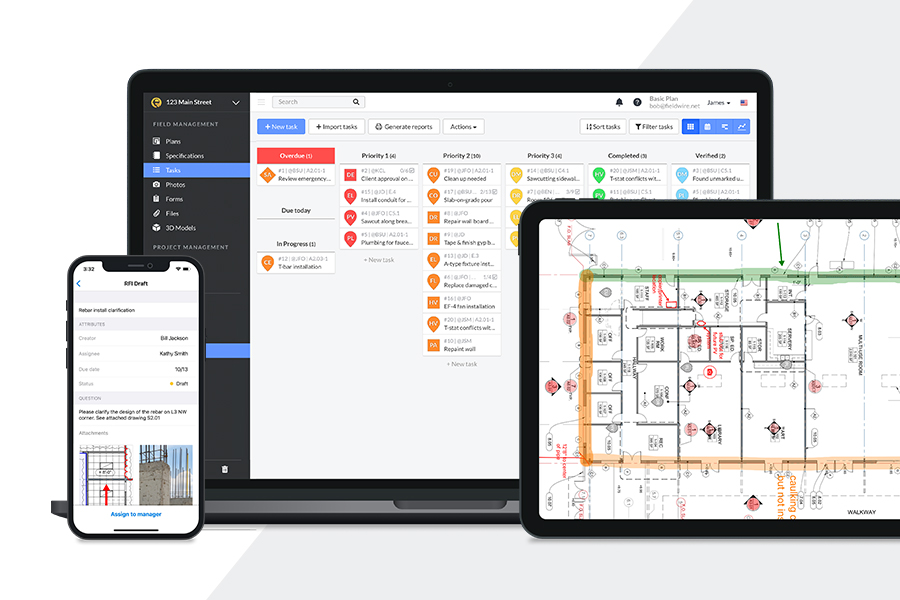
Start with the essentials: centralized plan management, digital task tracking, and real-time communication between field and office. When everyone is working from the same source of information, alignment improves almost immediately. This is the layer everything else builds on.
Phase 2: Standardize workflows
Once the foundation is in place, focus on consistency. Digital forms, QA/QC processes, and reporting templates reduce guesswork and improve repeatability across projects. Standardization is what makes efficiency scalable.
Phase 3: Connect your systems
As your stack matures, start integrating across financial systems, scheduling tools, and communication platforms. This is where data silos start to disappear and your information stays aligned across teams.
Phase 4: Optimize at scale
At this stage, you move from reactive management to proactive performance improvement. Cross-project dashboards, centralized tracking of RFIs, change orders, tasks, and forms. This is where leadership starts making better decisions faster, based on real data.
The human side of adoption
Technology implementation is ultimately a people challenge. The best platform in the world doesn't deliver value if teams don't use it. And resistance isn't a failure of will — it's usually a rational response from people who already feel stretched thin and aren't convinced the new system will actually make their day easier.
What works: ongoing training rather than a single rollout event, short and practical sessions that fit into how field teams actually work, internal champions who can support their peers, and consistent follow-up. The goal is to make the new tool feel like the easiest path, not an additional burden.
Starting small matters here too. When you can point to a specific project where digitizing one workflow saved time or prevented a mistake, that story travels. It builds credibility with skeptics and momentum with the rest of the team.
Tie every decision back to business outcomes
Technology for its own sake rarely delivers. Every tool your team adopts should connect to something tangible: higher productivity, better quality, lower risk, stronger profitability. When those connections are clear, adoption tends to follow naturally, because people understand why the change is happening.
We've seen mid-sized contractors achieve real, measurable results. Jarrell Mechanical used Fieldwire to manage plan markups and track mechanical work on a project that required a 10-week delivery window, making a timeline that would have been extremely difficult otherwise achievable. Blue Mountain Electric managed hundreds of plans and all electrical tasks digitally on a $50M retrofit. Colt Builders brought order to complex multi-family housing projects through consistent task and documentation management.
None of these teams needed enterprise-scale IT departments to get there. They needed a clear starting point and a willingness to prove value before expanding.

The advantage mid-sized contractors have right now
Here's something I genuinely believe: mid-sized contractors are in a stronger position than they often realize. Larger organizations move slowly. They have legacy systems, long procurement cycles, and cultural inertia that make change hard. Mid-sized contractors can move faster, test ideas on real projects, and build a digital foundation in the time it takes a larger competitor to finalize a software selection committee.
The window to build that advantage is open. Contractors who establish strong digital foundations now will be better positioned to win more competitive work, retain good people, and deliver more predictably as the industry continues to evolve.
Where to start tomorrow
If you're ready to move, here's a concrete starting point:
- Pick one workflow (plans, tasks, or forms) and digitize it on one or two projects.
- Invest in training and use your technology partner as a resource, not just a vendor.
- Track early wins: time saved, rework reduced, communication improved.
- Scale gradually, refining as you go.
The goal is building a foundation that makes your operations smarter, your teams more effective, and your project delivery more predictable. That starts with one project, one workflow, and a clear picture of what you're solving for.
You don't need to have everything figured out before you begin. You just need to begin.
Ready to begin? Schedule a call with a Fieldwire representative to learn how.
Frequently asked questions about software for mid-sized contractors
Start by diagnosing where information gets stuck between the field and the office. Most contractors find the biggest early wins come from centralizing plan management, digital task tracking, and real-time communication — then digitizing one workflow on one or two projects before expanding further.
It varies by workflow, but many teams see measurable improvements — fewer outdated drawings in circulation, faster RFI turnaround, less time spent searching for information — within the first one or two projects, especially when the rollout starts narrow and focused.
Involve field teams in the selection process from the start, run a proof of concept on real projects, and back the rollout with ongoing training rather than a one-time session. Internal champions who can support their peers day to day make a significant difference in how quickly a new tool sticks.
No. Contractors like Jarrell Mechanical, Blue Mountain Electric, and Colt Builders achieved significant results without enterprise-scale IT departments. What mattered was a clear starting point, a willingness to prove value on real projects, and a phased approach to scaling.
Trying to do too much at once. A phased approach — establishing the foundation, standardizing workflows, integrating systems, and then optimizing at scale — gives teams time to adjust and gives leadership a chance to prove ROI before expanding the investment.


